Breaking News
AWS Outage in Virginia Data Center Zone Causes Service Disruptions Across US-East-1 Region
2026-05-08
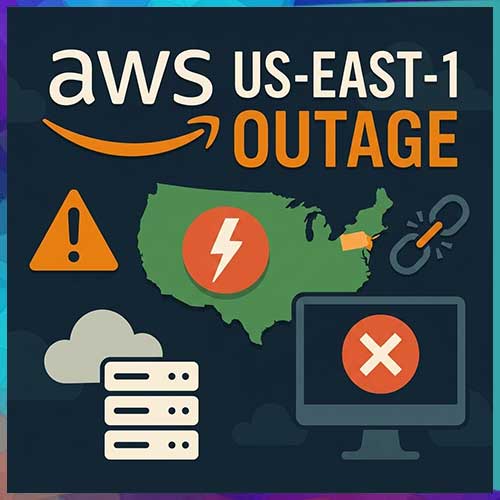
Amazon Web Services spent hours working to recover from a major outage tied to overheating issues inside a single data center in its critical US-EAST-1 region, triggering elevated error rates, latency, and service impairments across multiple cloud services.
The incident affected the use1-az4 Availability Zone in northern Virginia, one of the busiest infrastructure hubs in AWS’s global network. According to AWS status updates, the problems began after temperatures rose inside a single data center, causing power-related disruptions to affected hardware racks hosting EC2 instances and EBS storage volumes.
AWS said the outage impacted services including Amazon ElastiCache, Amazon Managed Streaming for Apache Kafka, Amazon OpenSearch Service, and Amazon SageMaker. Customers also experienced impairments across workloads dependent on affected EC2 and EBS infrastructure.
As the incident escalated, AWS shifted traffic away from the impacted Availability Zone for most services and advised customers to move workloads to unaffected zones within the US-EAST-1 region. The company also recommended restoring systems from EBS snapshots or launching replacement resources in unaffected zones for customers requiring immediate recovery.
In multiple updates through the evening, AWS acknowledged that recovery was progressing slower than expected as engineers worked to restore cooling systems and safely bring impacted racks back online. The company later reported “early signs of recovery” after additional cooling capacity was restored, though elevated error rates and latency persisted for some workflows.
By late Thursday night, AWS said it was continuing controlled recovery efforts and warned that some EC2 instances and EBS volumes would remain impaired until temperatures normalized fully and remaining racks were restored.
The disruption underscores the operational risks tied to hyperscale cloud infrastructure, where localized physical failures-such as cooling system issues—can cascade into broader service instability affecting enterprise workloads, AI platforms, and internet-scale applications.
US-EAST-1 is among AWS’s most heavily used regions globally and has historically been linked to several high-profile outages due to the concentration of customer workloads hosted there.
The incident affected the use1-az4 Availability Zone in northern Virginia, one of the busiest infrastructure hubs in AWS’s global network. According to AWS status updates, the problems began after temperatures rose inside a single data center, causing power-related disruptions to affected hardware racks hosting EC2 instances and EBS storage volumes.
AWS said the outage impacted services including Amazon ElastiCache, Amazon Managed Streaming for Apache Kafka, Amazon OpenSearch Service, and Amazon SageMaker. Customers also experienced impairments across workloads dependent on affected EC2 and EBS infrastructure.
As the incident escalated, AWS shifted traffic away from the impacted Availability Zone for most services and advised customers to move workloads to unaffected zones within the US-EAST-1 region. The company also recommended restoring systems from EBS snapshots or launching replacement resources in unaffected zones for customers requiring immediate recovery.
In multiple updates through the evening, AWS acknowledged that recovery was progressing slower than expected as engineers worked to restore cooling systems and safely bring impacted racks back online. The company later reported “early signs of recovery” after additional cooling capacity was restored, though elevated error rates and latency persisted for some workflows.
By late Thursday night, AWS said it was continuing controlled recovery efforts and warned that some EC2 instances and EBS volumes would remain impaired until temperatures normalized fully and remaining racks were restored.
The disruption underscores the operational risks tied to hyperscale cloud infrastructure, where localized physical failures-such as cooling system issues—can cascade into broader service instability affecting enterprise workloads, AI platforms, and internet-scale applications.
US-EAST-1 is among AWS’s most heavily used regions globally and has historically been linked to several high-profile outages due to the concentration of customer workloads hosted there.

See What’s Next in Tech With the Fast Forward Newsletter









Tweets From @varindiamag
Nothing to see here - yet
When they Tweet, their Tweets will show up here.